Cartilage in Baby's Nose Causing Noises While Breathing
Overview
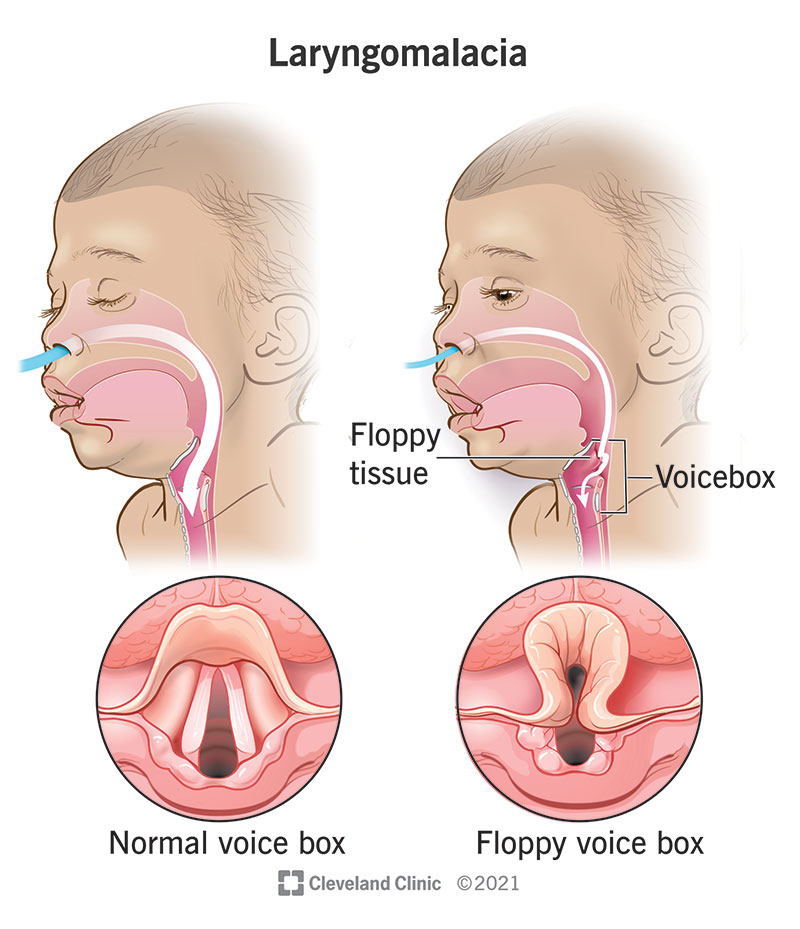
What is laryngomalacia?
Laryngomalacia is a type of vocalism box abnormality present in newborn babies. The status occurs when tissues located higher up the voice box are floppy and fall back over the airway. Laryngomalacia is the almost common cause of noisy breathing in babies. Laryngomalacia is congenital, meaning information technology is present at birth.
Laryngomalacia and tracheomalacia: What'south the departure?
Both laryngomalacia and tracheomalacia are atmospheric condition affecting the airway. While laryngomalacia refers to floppy tissues in a higher place the vocalisation box, tracheomalacia is characterized past floppy or weak cartilage of the windpipe. Tracheomalacia is far less mutual — and unremarkably more serious — than laryngomalacia.
Who does laryngomalacia affect?
Laryngomalacia primarily affects infants. Laryngomalacia in adults is very rare, but it can occur.
How common is laryngomalacia in babies?
This condition is extremely common in infants. Over one-half of all newborn babies take laryngomalacia during the start week of life, and fifty-fifty more than develop it when they're 2 to 4 weeks old.
Symptoms and Causes
What are the symptoms of laryngomalacia?
Babies with laryngomalacia may exhibit mild, moderate or severe symptoms. The most common sign of laryngomalacia is stridor (loud, squeaky noises that occur when your baby breathes in). Stridor symptoms often worsen over the first several months, merely resolve themselves inside one year. Even though stridor sounds concerning, most babies with laryngomalacia have no trouble breathing or feeding. In infants with mild laryngomalacia, breathing usually gets louder when lying downwards, sleeping, crying or feeding.
Though not equally mutual, some babies may accept severe laryngomalacia symptoms, which include:
- Loud, noisy animate.
- Difficulty swallowing (dysphagia).
- Apnea (long pauses in breathing).
- Cyanosis (a status that causes the pare to develop a bluish hue).
- Aspiration (pulling food into the lungs).
- Poor weight proceeds.
- GERD (chronic acid reflux).
- A tugging or "pulling in" at the neck or chest when breathing.
If your baby exhibits any of the symptoms listed above, call your healthcare provider correct abroad.
What causes laryngomalacia?
An verbal crusade is unknown, but experts believe it has something to exercise with the fashion the voice box develops in the womb. The muscles supporting the vox box may be also weak or relaxed. Additionally, GERD — which is mutual in babies with laryngomalacia — may make laryngomalacia symptoms worse.
Diagnosis and Tests
How is laryngomalacia diagnosed?
Your healthcare provider will conduct an examination and ask you virtually your baby'due south overall wellness. They may too perform a test called a nasopharyngolaryngoscopy (NPL), which uses a tiny camera to view your baby'due south voice box.
If a laryngomalacia diagnosis is made, other tests may be necessary to determine the extent of the condition. These may include:
- Neck or chest X-rays :** **These imaging tests can tell your healthcare provider if your baby has whatever other abnormalities that may be contributing to noisy breathing.
- Microlaryngoscopy and bronchoscopy (ML&B): A lighted scope is used to examine your infant'south windpipe and vox box to see what is causing loud breathing. ML&B is performed nether general anesthesia.
- Airway fluoroscopy: This procedure combines X-rays and a contrast amanuensis (such as a dye) that illuminates problematic areas within the body.
- Impedance probe: During this procedure, a small tube is inserted through the nose and into the esophagus. A measuring device is then used to measure the corporeality of breadbasket acrid that reaches the esophagus. Babies who undergo this procedure commonly stay for at least one night in the hospital.
Direction and Treatment
How is laryngomalacia treated?
In the bulk of cases, laryngomalacia goes away on its ain within 1 year. All the same, if your baby has severe laryngomalacia, medication or surgery may be necessary.
Laryngomalacia Medication
If GERD is contributing to your baby's laryngomalacia, your healthcare provider may prescribe an anti-reflux medication. GERD can worsen swelling associated with laryngomalacia, and so it'south of import to continue reflux in check if it's a contributing cistron.
Laryngomalacia Surgery
Laryngomalacia surgery involves trimming the weak, floppy tissue above the phonation box. This process is called supraglottoplasty and it's performed nether general anesthesia in an operating room.
How can I manage my baby'south symptoms?
Laryngomalacia management depends on your baby's unique situation and the severity of their condition. For infants that take feeding difficulties, thickened feeding or positional feeding can help ease symptoms. Your healthcare provider may also recommend that you identify your baby on their tummy to sleep. This helps keep the tissue from obstructing the airway. Inquire you provider virtually specific ways to manage your baby's laryngomalacia symptoms.
How long does it accept to recover from laryngomalacia treatment?
Following laryngomalacia surgery, your baby may really sound worse for a few days. This is normal, and it's due to inflammation and swelling around the vocal cords. The noisy breathing should gradually better, with full recovery taking about two weeks.
Prevention
Can laryngomalacia be prevented?
Because laryngomalacia is a built condition, at that place is currently no known way to prevent it from occurring.
Outlook / Prognosis
Is laryngomalacia life threatening?
Despite the associated noisy animate, laryngomalacia is usually not dangerous, as most babies with the condition are notwithstanding able to exhale. While near infants outgrow laryngomalacia, a few cases will crave surgery to correct the upshot.
Does laryngomalacia go away?
Yeah. In about cases, laryngomalacia goes away on its own by the time an infant turns one year old.
Living With
When should I be concerned nigh laryngomalacia?
If your baby shows mild symptoms of laryngomalacia, such every bit noisy breathing, consider scheduling an appointment with your healthcare provider. They can examine your baby and make recommendations for abode care and management. Call your provider if your baby develops sudden symptoms, or if they develop GERD.
When should I get to ER?
Caput to the nearest emergency room if your baby:
- Stops breathing for more than than 10 seconds at a time.
- Has a tugging or "pulling in" at the breast or neck, even afterwards existence awakened or repositioned.
- Turns blue around the lips.
A notation from Cleveland Dispensary
Laryngomalacia can be concerning, especially for new parents. In most cases, the condition isn't dangerous, fifty-fifty though noisy breathing can be alarming. However, information technology's always a skillful idea to schedule a consultation with your healthcare provider if you have whatever questions about your baby's health.
Source: https://my.clevelandclinic.org/health/diseases/22076-laryngomalacia
0 Response to "Cartilage in Baby's Nose Causing Noises While Breathing"
Post a Comment