Many Symbols in the Art of Benin Reflect the Belief That the Oba

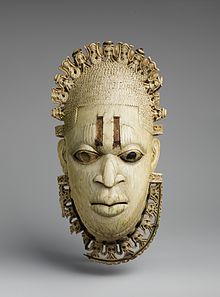

Statuary Head of Queen Idia
Benin art is the fine art from the Kingdom of Republic of benin or Edo Empire (1440–1897), a pre-colonial African state located in what is now known as the Southern region of Nigeria.[1] Primarily made of cast bronze and carved ivory, Benin fine art was produced mainly for the court of the Oba of Benin – a divine ruler for whom the craftsmen produced a range of ceremonially significant objects.[ citation needed ] The total complication of these works can be appreciated through the awareness and consideration of two complementary cultural perceptions of the art of Benin: the Western appreciation of them primarily as works of fine art, and their understanding in Benin as historical documents and as mnemonic devices to reconstruct history, or as ritual objects. This original significance is of great importance in Benin.[ii]
Chronology [edit]
Given the stylistic differences, the fine art of Benin has been divided by some authors, including Egyptologist Boris de Rachewiltz in the following periods:
| No. | Name | Duration |
|---|---|---|
| 1 | the Archaic Period | from the origins-1360 |
| 2 | the Ancient Period | 1360–1500 |
| 3 | the Flowering Period | 1500–1575 |
| four | the Apogee Catamenia | 1575–1648 |
| v | the "Renaissance" | 1648–1691 |
| 6 | the Decline Period | 1691–1819 |
[iii]
The regal arts of Benin [edit]
The royal arts of the Benin Kingdom of southern region Nigeria assert the centrality of the Oba, or divine king, portraying his divine nature. While recording the kingdom's significant historical events and the Oba's involvement with them, they also initiate the Oba'south interactions with the supernatural and honor his deified ancestors, forging a continuity that is vital to the kingdom'south well-beingness.[four]
The materials used in Republic of benin'southward royal arts—primarily brass, ivory, and coral—are endowed with sacred power. The innate value of these materials within Benin and the time and skill that is invested in working them reflect the earthly and otherworldly influence of the Oba and the keen wealth of his kingdom. Benin's imperial arts belong to a tradition that favors convention even equally information technology promotes creativity and innovation, particularly as a reflection of royal prerogative. Through time, rulers have used the arts to translate the history of the kingdom and to orient themselves with the past in an effort to support their ain initiatives and ascertain their images for posterity.[5]
Although only popularly known to Western audiences later on the Benin Expedition of 1897,[6] Republic of benin fine art has been in existence since at least the 13th century.
Ancestral altars [edit]
A newly installed Oba is responsible for creating an altar defended to his father, commissioning the appropriate objects to adorn it and activating it on a regular ground with sacrifices of nutrient or fauna blood. The Oba does the same for his mother if she attained the title of iyoba, or queenmother. While bells and rattle staffs are placed on all ancestral altars, ivory tusks and commemorative brass heads are made specifically for royal altars. Associated with trade, ivory and brass are durable and valuable, and their colors—white like sacred kaolin clay and carmine like fire and coral beads—relate to imperial power.[7]
Before the British conquest, an Oba'south courtyard was the focal betoken for rituals in his honor. British troops reported 18 altars dedicated to previous Obas when they took possession of the palace in 1897. Today, all of the imperial altars stand together in a single courtyard.[4]
One of the objects unique to Benin fine art is an Ikegobo, or "altar to the manus," which celebrates the accomplishments of exceptional individuals. The hand is associated with action and productivity, and is considered the source of wealth, status, and success for all those who depend on transmission skill and physical strength. Altars of this kind are deputed in terracotta, wood, or brass, depending on the status of the patron.[viii]
[edit]

This ivory double bong (Egogo) is one of the oldest surviving African ivory sculptures; only half dozen of these ivory gongs are known. They were used by the oba during the Emobo ceremony to drive abroad evil spirits. Carved with the oba, supported by his military commander and his heir.
Private and public ceremonies mark many of the important moments in Benin'southward yearly agenda. In the past, an elaborate series of rites were performed throughout the year to secure otherworldly back up for the kingdom's well-existence and to celebrate decisive events in its history. For the sake of convenience, the electric current monarch, Oba Ewuare II, emphasizes the end-of-twelvemonth festival called Igue, which is held during the winter holidays to permit the greatest number of people to attend. Igue includes a sequence of rituals that renew the Oba'southward supernatural powers and cleanse the kingdom'southward unruly spirits.[9]
Benin's other important ritual festivals include Ague, where the kickoff budded yams are blessed in hopes of a successful harvest; Ugie Ivie, the Festival of Chaplet, in which the Oba's coral and red stone regalia is bathed in cow's blood to reinvest it with spiritual force; Ugie Erha Oba, which honors the Oba'south begetter and all paternal ancestors; Oduduwa, a masquerade that likewise honors the )ba's paternal ancestors; and Ugie Oro, celebrating Oba Esigie'south victory over the Idah Kingdom in the 16th century.[x]
Finely carved ivory double gongs are examples of art related to rituals at court. They are called "double" gongs because of second, smaller resonating cups at their front. Typically, the key epitome is the Oba in coral regalia supported by the loftier priests Osa and Osuan, officials who tend the altars of the kingdom's two patron gods. These gongs are still carried today past the Oba during Emobo, the last of the empowering rites of the Igue festival. The Oba gently taps the ivory instrument, creating a rhythmic sound to calm and dismiss unruly spirits from the kingdom.[11]
Leopard imagery in the arts of Benin [edit]
The Oba is referred to metaphorically as "the leopard of the house," and images of the cute, cunning, and immensely dangerous cat appear oft in Benin's purple arts. Earlier the British invasion in 1897, domesticated leopards were kept in the palace to demonstrate the Oba'south mastery over the wilderness. Leopard imagery is also frequently linked to the Oba's military might.[12]
-

Box in the course of a leopard's head; 19th century; 17.1 x 14 cm (6 3⁄iv x 5 1⁄2 in.); Brooklyn Museum (New York City). This box was used to hold kola nuts presented to visitors in the royal court of Benin. Leopards are one of the about ordinarily portrayed animals in African art. Intelligent and courageous, they often serve equally metaphors for powerful individuals or associations
The Oba'south regalia [edit]
The Oba's divine right to rule is reiterated in his regalia. His coral crowns, shirts, aprons, necklaces, and accessories refer to those that Oba Ewuare is said to take stolen from Olokun, the god of the waters and prosperity. Coral and red stones such equally jasper and agate are too filled with supernatural free energy, or ase, every bit are elephant ivory and contumely, two other valuable materials that the Oba has historically controlled.[13]
Despite his divine status, the Oba can not rule alone. He must rely on others to fulfill his destiny, a dependence that is physically expressed when he walks or sits with his arms supported at the elbows and wrists past attendants. They help him behave the weight of his regalia, a abiding reminder of the burden of kingship.[4]
Brass casting [edit]
Contumely casters (igun eronmwon) are the highest-ranking arts and crafts guild within the hierarchical structure of the Iwebo lodge, followed by blacksmiths (igun ematon) and ivory and wood carvers (igbesanwan).[14]
The origins of brass casting in Benin are debated. 1 pop story credits Oba Oguola (enthroned c. 1280) with sending for a primary brass caster from Ile Ife, the capital city of the ancient Ife Kingdom to the northwest, and with later establishing a royal contumely-casting social club.[xv] [16] Others suggest brass casting developed independently in Benin and may accept mutually benefited from substitution with Ile Ife.[17] Casters in both regions used the lost wax method, in which a precisely detailed wax model is formed over a dirt core. When the model is complete, dirt is carefully applied over the wax. It is then heated, melting the wax, which exits from a narrow channel. Side by side, molten metal is poured into the mold. In one case cool, the hardened clay is chipped abroad, leaving behind an image now cast in bronze.[2] [18]
-

Portrait of the king Osemwende; circa 1810; Rietberg Museum
The Punitive Expedition [edit]
The pass up of Benin art occurred at the terminate of the 19th century when the Benin Trek of 1897[half dozen] [19] [20] past the British caused impairment in the creation of the arts. On February 18, 1897, the British arrived in Benin Metropolis to punish a massacre. The possessions of the Oba and his court became spoils of war. The objects were rounded upward with fiddling regard for their associated meaning; no systematic record was kept of their grouping or placement. Many of these objects were sold in London to defray the price of the trek.[21] [22] [23]
In April 2021 Germany agreed to return to nowadays-day Nigeria the Republic of benin bronzes that their troops had looted from the Kingdom of Benin.[24] In late 2021 the Smithsonian Museum of African Fine art in Washington DC removed the Benin bronzes that they have from display and they say they take plans to repatriate them.[25] [26]
References [edit]
- ^ "Benin | historical kingdom, Due west Africa". Encyclopedia Britannica . Retrieved 2021-07-x .
- ^ a b Barbara Plankensteiner, ed. (2007). Benin- Kings and Rituals: Court Art from Nigeria. Exhibition catalogue Kunsthistoriches Museum Vienna mit MVK und OTM/Snoeck.
- ^ Mihăilescu, Plutarh-Antoniu (1968). Întâlnire cu arta africană (in Romanian). Editura Meridiane. p. 48.
- ^ a b c "Republic of benin—Kings and Rituals: Court Arts from Nigeria". The Art Institute of Chicago. Retrieved two April 2013.
- ^ "Overview | The Art Institute of Chicago". archive.artic.edu . Retrieved 2021-05-24 .
- ^ a b Robert., Dwelling (1983). City of blood revisited : a new look at the benin expedition of 1897. Rowman & Littlefield. ISBN0-8476-4824-9. OCLC 795371327.
- ^ "The Royal Altars | The Art Plant of Chicago". archive.artic.edu . Retrieved 2021-05-24 .
- ^ "Oba with Animals, Altar to the Paw (Ikegobo) of Ezomo Ehenua [Nigeria; Edo peoples, court of Benin] (1991.17.113,1996.11)". Heilbrunn Timeline of Art History. New York: The Metropolitan Museum of Art. 2000. Retrieved iii Apr 2013.
- ^ "Rituals at Courtroom | The Art Establish of Chicago". archive.artic.edu . Retrieved 2021-07-09 .
- ^ "Rituals at Courtroom | The Art Constitute of Chicago". archive.artic.edu . Retrieved 2021-07-09 .
- ^ "Double-Gong and Striker | The Art Establish of Chicago". archive.artic.edu . Retrieved 2021-07-09 .
- ^ "The Oba: Leopard of the House (Ekpen N'Owa) | The Art Establish of Chicago". annal.artic.edu . Retrieved 2021-07-ten .
- ^ "The Oba: Leopard of the House (Ekpen Due north'Owa) | The Art Institute of Chicago". archive.artic.edu . Retrieved 2021-07-09 .
- ^ "Republic of benin Bronze casting: The story of ability and royalty…". Vanguard News. 2010-04-10. Retrieved 2021-07-10 .
- ^ Inneh, David (2007). Barbara Plankensteiner (ed.). Benin kings and rituals : court arts from Nigeria. Ghent: Snoeck. ISBN978-9053496268.
- ^ Egharevba, Jacob U. (1968). A Brusk History of Benin, 4th Edition. Ibadan University Press.
- ^ Gore, Charles (Summertime 1997). "Casting Identities in Gimmicky Benin". African Arts. 30 (3): 54–61, 93. doi:10.2307/3337500. JSTOR 3337500.
- ^ Jeffreys, Thou. D. W. (June 1951). "The origins of the Republic of benin bronzes". African Studies. x (2): 87–92. doi:10.1080/00020185108706840. ISSN 0002-0184.
- ^ "What are the Republic of benin bronzes, and why are they so controversial?". world wide web.aljazeera.com . Retrieved 2021-07-12 .
- ^ "Nigeria demands unconditional return of looted artefacts from Germany". 2021-07-08. Retrieved 2021-07-12 .
- ^ "What was life like in Republic of benin?". BBC Bitesize . Retrieved 2021-07-10 .
- ^ "The kingdom of Benin was obliterated past the British, who still have the testify on display". www.abc.net.au. 2020-11-29. Retrieved 2021-07-12 .
- ^ Marshall, Alex (2020-01-23). "This Art Was Looted 123 Years Agone. Will It Ever Be Returned?". The New York Times. ISSN 0362-4331. Retrieved 2021-07-12 .
- ^ "Republic of benin Bronzes: Germany to render looted artefacts to Nigeria". BBC News. 2021-04-30. Retrieved 2021-07-12 .
- ^ Catherine Hickley (28 Oct 2021). "Smithsonian Museum of African Art removes Benin bronzes from display and plans to repatriate them". CNN.
- ^ Maximiliano Duron (5 Nov 2021). "Smithsonian's Museum of African Art Begins Process to Repatriate Its Republic of benin Bronzes". Art News.
External links [edit]
- Penn Museum – Republic of benin Collection
- Art and oracle: African fine art and rituals of divination, an exhibition catalog from The Metropolitan Museum of Art (fully bachelor online as PDF), which contains material on Benin fine art
- Majestic Art of Benin: The Perls Drove, an exhibition itemize from The Metropolitan Museum of Fine art (fully available online equally PDF)
- Antiquities from the city of Benin and from other parts of West Africa in the British Museum, a catalog from The British Museum (fully available online equally PDF)
- Art of Oceania, Africa, and the Americas from the Museum of Primitive Fine art: an exhibition at the Metropolitan Museum of Fine art, an exhibition itemize from The Metropolitan Museum of Art Libraries (fully available online every bit PDF)
- Benin Collections in the Archive of Folk Culture, from the American Folklife Center
- "This Fine art was Looted 123 Years Agone. Will It Ever Exist Returned?" January 2020 article about the Republic of benin Bronzes from the New York Times
- Work by Beninese artists at the University of Michigan Museum of Art
Source: https://en.wikipedia.org/wiki/Art_of_the_Kingdom_of_Benin
0 Response to "Many Symbols in the Art of Benin Reflect the Belief That the Oba"
Post a Comment