whats the secert way to spy on a cell phone using the icc id or meic number undectected and free
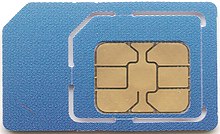
A typical SIM card (mini-SIM with micro-SIM cutout)

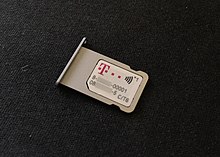
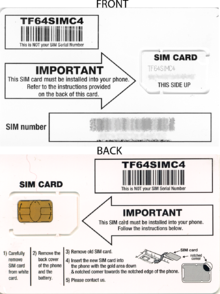
A TracFone Wireless SIM carte has no distinctive carrier markings and is only marked as a "SIM card"
A SIM menu (full form Subscriber Identity Module or Subscriber Identification Module),[i] is an integrated excursion intended to deeply store the international mobile subscriber identity (IMSI) number and its related key, which are used to identify and authenticate subscribers on mobile telephony devices (such as mobile phones and computers). Information technology is also possible to store contact information on many SIM cards. SIM cards are ever used on GSM phones; for CDMA phones, they are needed but for LTE-capable handsets. SIM cards can also be used in satellite phones, smart watches, computers, or cameras.[two]
The SIM circuit is part of the function of a universal integrated circuit card (UICC) concrete smart card, which is ordinarily fabricated of PVC with embedded contacts and semiconductors. SIM cards are transferable between different mobile devices. The commencement UICC smart cards were the size of credit and banking concern cards; sizes were reduced several times over the years, usually keeping electrical contacts the aforementioned, so that a larger card could exist cut down to a smaller size.
A SIM menu contains a unique serial number (ICCID), international mobile subscriber identity (IMSI) number, security hallmark and ciphering information, temporary information related to the local network, a list of the services the user has admission to, and two passwords: a personal identification number (Pivot) for ordinary use, and a personal unblocking key (PUK) for PIN unlocking. In Europe, the serial SIM number (SSN) is also sometimes accompanied past an international article number (IAN) or a European article number (EAN) required when registering online for the subscription of a prepaid menu.
History and procurement [edit]
The SIM card is a type of smart menu,[2] the footing for which is the silicon integrated circuit (IC) scrap.[3] The thought of incorporating a silicon IC fleck onto a plastic card originates from the belatedly 1960s.[3] Smart cards have since used MOS integrated circuit chips, forth with MOS memory technologies such as wink memory and EEPROM (electrically erasable programmable read-only retentiveness).[four]
The SIM was initially specified by the European Telecommunications Standards Found in the specification with the number TS 11.11. This specification describes the concrete and logical behaviour of the SIM. With the development of UMTS, the specification work was partially transferred to 3GPP. 3GPP is now responsible for the further development of applications like SIM (TS 51.011[5]) and USIM (TS 31.102[six]) and ETSI for the further development of the physical card UICC.
The first SIM card was developed in 1991 by Munich smart-card maker Giesecke & Devrient, who sold the first 300 SIM cards to the Finnish wireless network operator Radiolinja.[7] [viii]
Today, SIM cards are ubiquitous, assuasive over seven billion devices to connect to cellular networks around the world. Co-ordinate to the International Bill of fare Manufacturers Association (ICMA), there were 5.iv billion SIM cards manufactured globally in 2016 creating over $half-dozen.5 billion in revenue for traditional SIM card vendors.[ix] The rise of cellular IoT and 5G networks is predicted to bulldoze the growth of the addressable market for SIM menu manufacturers to over 20 billion cellular devices past 2020.[10] The introduction of embedded-SIM (eSIM) and remote SIM provisioning (RSP) from the GSMA[11] may disrupt the traditional SIM menu ecosystem with the entrance of new players specializing in "digital" SIM card provisioning and other value-added services for mobile network operators.[4]
Design [edit]
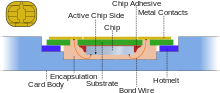
SIM flake structure and packaging
There are iii operating voltages for SIM cards: v V, 3 V and 1.8 V (ISO/IEC 7816-3 classes A, B and C, respectively). The operating voltage of the majority of SIM cards launched before 1998 was 5 V. SIM cards produced afterwards are compatible with 3 V and 5 V. Modern cards support v Five, 3 5 and ane.eight V.[4]
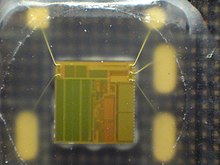
4 past 4 millimetres (0.16 in × 0.16 in) silicon chip in a SIM card which has been peeled open. Note the thin gilded bonding wires, and the regular, rectangular digital retention areas.
Mod SIM cards allow applications to load when the SIM is in use by the subscriber. These applications communicate with the handset or a server using SIM Application Toolkit, which was initially specified by 3GPP in TS 11.14. (There is an identical ETSI specification with different numbering.) ETSI and 3GPP maintain the SIM specifications. The main specifications are: ETSI TS 102 223 (the toolkit for smartcards), ETSI TS 102 241 (API), ETSI TS 102 588 (application invocation), and ETSI TS 131 111 (toolkit for more than SIM-likes). SIM toolkit applications were initially written in native code using proprietary APIs. To provide interoperability of the applications, ETSI chose Java Card.[12] A multi-visitor collaboration called GlobalPlatform defines some extensions on the cards, with additional APIs and features similar more cryptographic security and RFID contactless use added.[13]
Data [edit]
SIM cards shop network-specific data used to authenticate and place subscribers on the network. The most of import of these are the ICCID, IMSI, authentication fundamental (Yardi), local area identity (LAI) and operator-specific emergency number. The SIM also stores other carrier-specific data such as the SMSC (Brusk Message service eye) number, service provider proper noun (SPN), service dialling numbers (SDN), advice-of-charge parameters and value-added service (VAS) applications. (Refer to GSM 11.11.[fourteen])
SIM cards can come in various information capacities, from eight KB to at to the lowest degree 256 KB.[8] All can store a maximum of 250 contacts on the SIM, simply while the 32 KB has room for 33 mobile network codes (MNCs) or network identifiers, the 64 KB version has room for 80 MNCs.[15] This is used by network operators to shop data on preferred networks, generally used when the SIM is not in its home network but is roaming. The network operator that issued the SIM carte du jour can utilize this to have a phone connect to a preferred network that is more than economic for the provider instead of having to pay the network operator that the phone discovered first. This does not mean that a phone containing this SIM card tin can connect to a maximum of only 33 or 80 networks, only it means that the SIM card issuer can specify just up to that number of preferred networks. If a SIM is exterior these preferred networks information technology uses the starting time or best available network.[10]
ICCID [edit]
Each SIM is internationally identified by its integrated excursion card identifier (ICCID). ICCID is the identifier of the actual SIM carte du jour itself – i.e. an identifier for the SIM chip. Nowadays ICCID numbers are besides used to identify eSIM profiles, and not but physical SIM cards. ICCIDs are stored in the SIM cards and are also engraved or printed on the SIM card body during a process called personalisation. The ICCID is defined by the ITU-T recommendation Due east.118 as the primary business relationship number.[sixteen] Its layout is based on ISO/IEC 7812. According to E.118, the number can be upward to 19 digits long, including a single cheque digit calculated using the Luhn algorithm. Even so, the GSM Phase 1[17] defined the ICCID length as an opaque information field, 10 octets (xx digits) in length, whose structure is specific to a mobile network operator.
The number is composed of the following subparts:
Issuer identification number (IIN)
Maximum of 7 digits:
- Major manufacture identifier (MII), 2 fixed digits, 89 for telecommunication purposes.
- Country code, 2 or three digits, as divers by ITU-T recommendation East.164.
- NANP countries, autonomously from Canada, use 01, i.east. prepending a null to their common calling code +1
- Canada uses 302
- Russian federation uses 701, i.e. appending 01 to its calling code +seven
- Kazakhstan uses 997, fifty-fifty though information technology shares the calling code +seven with Russian federation
- Issuer identifier, 1–iv digits.
- Often identical to the mobile network code (MNC).[eighteen]
Individual account identification
- Individual account identification number. Its length is variable, but every number under one IIN has the same length.
- Ofttimes identical to the mobile subscription identification number (MSIN).[3]
Check digit
- Single digit calculated from the other digits using the Luhn algorithm.
With the GSM Stage 1 specification using 10 octets into which ICCID is stored every bit packed BCD, the information field has room for twenty digits with hexadecimal digit "F" being used as filler when necessary.
In practice, this means that on GSM SIM cards there are 20-digit (19+ane) and 19-digit (18+1) ICCIDs in use, depending upon the issuer. However, a unmarried issuer always uses the same size for its ICCIDs.
To confuse matters more, SIM factories seem to accept varying ways of delivering electronic copies of SIM personalization datasets. Some datasets are without the ICCID checksum digit, others are with the digit.
Every bit required past E.118, the ITU-T updates a list of all electric current internationally assigned IIN codes in its Operational Bulletins which are published twice a month (the last every bit of January 2019 was No. 1163 from 1 January 2019).[xix] ITU-T as well publishes consummate lists: every bit of January 2019, the list issued on one December 2018 was current, having all issuer identifier numbers before i Dec 2018.[20]
International mobile subscriber identity (IMSI) [edit]
SIM cards are identified on their private operator networks by a unique international mobile subscriber identity (IMSI). Mobile network operators connect mobile phone calls and communicate with their market SIM cards using their IMSIs. The format is:
- The offset three digits represent the mobile state lawmaking (MCC).
- The next two or three digits represent the mobile network code (MNC). 3-digit MNC codes are allowed past E.212 merely are mainly used in the United states and Canada. 1 MCC can have both two digit and 3 digit MNCs, an example is 350 007.
- The next digits represent the mobile subscriber identification number (MSIN). Unremarkably at that place are ten digits, but tin be fewer in the instance of a three-digit MNC or if national regulations betoken that the total length of the IMSI should be less than 15 digits.
- Digits are different from state to land.
Hallmark fundamental (Thoui) [edit]
The Mi is a 128-fleck value used in authenticating the SIMs on a GSM mobile network (for USIM network, y'all still need Ki but other parameters are also needed). Each SIM holds a unique Ki assigned to it by the operator during the personalization procedure. The Thousandi is too stored in a database (termed hallmark heart or AuC) on the carrier's network.
The SIM card is designed to prevent someone from getting the 1000i by using the smart-card interface. Instead, the SIM card provides a function, Run GSM Algorithm, that the phone uses to pass data to the SIM menu to be signed with the Grandi. This, by blueprint, makes using the SIM card mandatory unless the One thousandi tin can exist extracted from the SIM carte, or the carrier is willing to reveal the 1000i. In practice, the GSM cryptographic algorithm for computing a signed response (SRES_1/SRES_2: see steps 3 and 4, beneath) from the Ki has certain vulnerabilities[xv] that can permit the extraction of the 1000i from a SIM bill of fare and the making of a duplicate SIM bill of fare.
Authentication process:
- When the mobile equipment starts upwards, information technology obtains the international mobile subscriber identity (IMSI) from the SIM card, and passes this to the mobile operator, requesting access and authentication. The mobile equipment may have to pass a Pin to the SIM card before the SIM carte du jour reveals this information.
- The operator network searches its database for the incoming IMSI and its associated Ki.
- The operator network then generates a random number (RAND, which is a nonce) and signs information technology with the Mi associated with the IMSI (and stored on the SIM card), computing another number, that is split into the Signed Response ane (SRES_1, 32 bits) and the encryption key 1000c (64 bits).
- The operator network then sends the RAND to the mobile equipment, which passes it to the SIM bill of fare. The SIM card signs it with its Ki, producing Signed Response two (SRES_2) and Kc, which it gives to the mobile equipment. The mobile equipment passes SRES_2 on to the operator network.
- The operator network then compares its computed SRES_1 with the computed SRES_2 that the mobile equipment returned. If the ii numbers match, the SIM is authenticated and the mobile equipment is granted access to the operator's network. Kc is used to encrypt all further communications between the mobile equipment and the operator.
Location area identity [edit]
The SIM stores network country information, which is received from the location area identity (LAI). Operator networks are divided into location areas, each having a unique LAI number. When the device changes locations, it stores the new LAI to the SIM and sends it back to the operator network with its new location. If the device is ability cycled, it takes data off the SIM, and searches for the prior LAI.
SMS letters and contacts [edit]
Well-nigh SIM cards store a number of SMS messages and phone book contacts. It stores the contacts in simple "proper name and number" pairs. Entries that contain multiple telephone numbers and additional phone numbers are commonly non stored on the SIM card. When a user tries to copy such entries to a SIM, the handset's software breaks them into multiple entries, discarding data that is not a phone number. The number of contacts and messages stored depends on the SIM; early models stored as few every bit five letters and 20 contacts, while modern SIM cards can unremarkably store over 250 contacts.[21]
Formats [edit]
SIM cards have been made smaller over the years; functionality is independent of format. Total-size SIM was followed by mini-SIM, micro-SIM, and nano-SIM. SIM cards are also made to embed in devices.

From left, full-size SIM (1FF), mini-SIM (2FF), micro-SIM (3FF), and nano-SIM (4FF)
All versions of the non-embedded SIM cards share the same ISO/IEC 7816 pin arrangement.
Full-size SIM [edit]
The total-size SIM (or 1FF, 1st form factor) was the first form factor to appear. Information technology was the size of a credit card (85.sixty mm × 53.98 mm × 0.76 mm). Later smaller SIMs are often supplied embedded in a full-size card from which they can be removed.
Mini-SIM [edit]
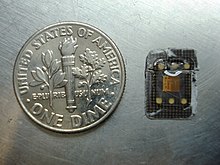
The retention fleck from a micro-SIM card without the plastic backing plate, adjacent to a US dime, which is approx. 18 mm in bore

X-ray image of a mini-SIM, showing the chip and connections
The mini-SIM (or 2FF) card has the aforementioned contact arrangement as the total-size SIM card and is normally supplied within a total-size card carrier, attached by a number of linking pieces. This organization (defined in ISO/IEC 7810 as ID-one/000) lets such a card exist used in a device that requires a full-size card – or in a device that requires a mini-SIM card, afterward breaking the linking pieces. As the total-size SIM is no longer used, some suppliers refer to the mini-SIM as a "standard SIM" or "regular SIM".
Micro-SIM [edit]
The micro-SIM (or 3FF) menu has the same thickness and contact arrangements, simply reduced length and width as shown in the table above.[22]
The micro-SIM was introduced past the European Telecommunications Standards Establish (ETSI) along with SCP, 3GPP (UTRAN/GERAN), 3GPP2 (CDMA2000), ARIB, GSM Association (GSMA SCaG and GSMNA), GlobalPlatform, Freedom Brotherhood, and the Open Mobile Alliance (OMA) for the purpose of fitting into devices as well small for a mini-SIM card.[eighteen] [23]
The form factor was mentioned in the December 1998 3GPP SMG9 UMTS Working Party, which is the standards-setting trunk for GSM SIM cards,[21] and the form factor was agreed upon in late 2003.[24]
The micro-SIM was designed for astern compatibility. The major issue for astern compatibility was the contact area of the chip. Retaining the aforementioned contact area makes the micro-SIM compatible with the prior, larger SIM readers through the apply of plastic cutout surrounds. The SIM was also designed to run at the same speed (5 MHz) as the prior version. The same size and positions of pins resulted in numerous "How-to" tutorials and YouTube videos with detailed instructions how to cutting a mini-SIM card to micro-SIM size.[25]
The chairman of EP SCP, Dr Klaus Vedder, said[24]
ETSI has responded to a market need from ETSI customers, just additionally there is a strong want not to invalidate, overnight, the existing interface, nor reduce the functioning of the cards.
Micro-SIM cards were introduced by diverse mobile service providers for the launch of the original iPad, and afterwards for smartphones, from April 2010. The iPhone iv was the offset smartphone to utilise a micro-SIM bill of fare in June 2010, followed by many others.
Nano-SIM [edit]
The nano-SIM (or 4FF) bill of fare was introduced on 11 October 2012, when mobile service providers in various countries started to supply it for phones that supported the format. The nano-SIM measures 12.iii mm × viii.eight mm × 0.67 mm (0.484 in × 0.346 in × 0.026 in) and reduces the previous format to the contact area while maintaining the existing contact arrangements. A small rim of isolating material is left around the contact area to avoid short circuits with the socket. The nano-SIM is 0.67 mm (0.026 in) thick, compared to the 0.76 mm (0.030 in) of its predecessors. 4FF can be put into adapters for use with devices designed for 2FF or 3FF SIMs, and is made thinner for that purpose,[26] and phone companies requite due alarm almost this.[27]
The iPhone 5, released in September 2012, was the first device to utilize a nano-SIM card, followed by other handsets.
Security [edit]
In July 2013, Karsten Nohl, a security researcher from SRLabs, described[28] [29] vulnerabilities in some SIM cards that supported DES, which, despite its age, is still used by some operators.[29] The set on could lead to the telephone being remotely cloned or allow someone steal payment credentials from the SIM.[29] Further details of the research were provided at BlackHat on 31 July 2013.[29] [xxx]
In response, the International Telecommunication Union said that the development was "hugely significant" and that it would be contacting its members.[31]
In February 2015, it was reported by The Intercept that the NSA and GCHQ had stolen the encryption keys (Ki'southward) used by Gemalto (the manufacturer of 2 billion SIM cards annually), enabling these intelligence agencies to monitor voice and data communications without the knowledge or approval of cellular network providers or judicial oversight.[32] Having finished its investigation, Gemalto claimed that information technology has "reasonable grounds" to believe that the NSA and GCHQ carried out an performance to hack its network in 2010 and 2011, only says the number of possibly stolen keys would non accept been massive.[33]
In September 2019, Cathal Mc Daid, a security researcher from AdaptiveMobile Security, described[34] [35] how vulnerabilities in some SIM cards that contained the S@T Browser library were being actively exploited. This vulnerability was named Simjacker. Attackers were using the vulnerability to track the location of thousands of mobile telephone users in several countries.[36] Further details of the research were provided at VirusBulletin on iii October 2019.[37] [38]
Developments [edit]
When GSM was already in use, the specifications were further developed and enhanced with functionality such as SMS and GPRS. These development steps are referred as releases past ETSI. Within these evolution cycles, the SIM specification was enhanced every bit well: new voltage classes, formats and files were introduced.
USIM [edit]
In GSM-but times, the SIM consisted of the hardware and the software. With the advent of UMTS, this naming was divide: the SIM was now an application and hence only software. The hardware part was called UICC. This split up was necessary because UMTS introduced a new application, the universal subscriber identity module (USIM). The USIM brought, among other things, security improvements like mutual authentication and longer encryption keys and an improved address book.
UICC [edit]
"SIM cards" in adult countries today are usually UICCs containing at to the lowest degree a SIM awarding and a USIM application. This configuration is necessary because older GSM but handsets are solely uniform with the SIM application and some UMTS security enhancements rely on the USIM application.
Other variants [edit]
On cdmaOne networks, the equivalent of the SIM menu is the R-UIM and the equivalent of the SIM application is the CSIM.
A virtual SIM is a mobile phone number provided past a mobile network operator that does not crave a SIM card to connect telephone calls to a user's mobile phone.
Embedded-SIM (eSIM) [edit]
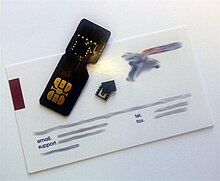
Embedded SIM from M2M supplier Eseye with an adapter lath for evaluation in a mini-SIM socket
An embedded SIM (eSIM) is a form of programmable SIM that is embedded straight into a device. The surface mount format provides the same electrical interface as the total size, 2FF and 3FF SIM cards, but is soldered to a circuit board as part of the manufacturing process. In M2M applications where there is no requirement[xi] to change the SIM card, this avoids the requirement for a connector, improving reliability and security. An eSIM can be provisioned remotely; terminate-users can add or remove operators without the demand to physically swap a SIM from the device.[39]
Usage in mobile telephone standards [edit]
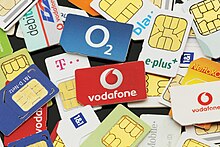
SIM cards of various German mobile operators
The use of SIM cards is mandatory in GSM devices.
The satellite phone networks Iridium, Thuraya and Inmarsat's BGAN also use SIM cards. Sometimes, these SIM cards piece of work in regular GSM phones and besides allow GSM customers to roam in satellite networks by using their ain SIM cards in a satellite phone.
Japan's 2G PDC system (which was shut down in 2012; SoftBank Mobile has already shut down PDC from 31 March 2010) too specifies a SIM, simply this has never been implemented commercially. The specification of the interface between the Mobile Equipment and the SIM is given in the RCR STD-27 annexe 4. The Subscriber Identity Module Skillful Group was a commission of specialists assembled past the European Telecommunications Standards Institute (ETSI) to draw up the specifications (GSM xi.11) for interfacing between smart cards and mobile telephones. In 1994, the proper name SIMEG was inverse to SMG9.
Japan'south current and next-generation cellular systems are based on W-CDMA (UMTS) and CDMA2000 and all use SIM cards. Nevertheless, Japanese CDMA2000-based phones are locked to the R-UIM they are associated with and thus, the cards are not interchangeable with other Japanese CDMA2000 handsets (though they may exist inserted into GSM/WCDMA handsets for roaming purposes outside Nippon).
CDMA-based devices originally did non use a removable card, and the service for these phones is spring to a unique identifier contained in the handset itself. This is near prevalent in operators in the Americas. The starting time publication of the TIA-820 standard (too known as 3GPP2 C.S0023) in 2000 divers the Removable User Identity Module (R-UIM). Card-based CDMA devices are most prevalent in Asia.
The equivalent of a SIM in UMTS is called the universal integrated circuit card (UICC), which runs a USIM application. The UICC is withal colloquially called a SIM card.[40]
-

SIM card for Thuraya satellite phone
-
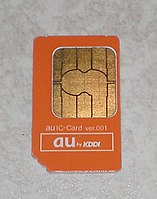
-

-

SIM card with a mobile phone
-

Three United kingdom SIM card with packaging
-

A mini-SIM carte du jour next to its electric contacts in a Nokia 6233
-

Nano-SIM card
SIM and carriers [edit]
The SIM card introduced a new and meaning business organisation opportunity for MVNOs – mobile virtual network operators – who lease capacity from ane of the network operators rather than owning or operating a cellular telecoms network and but provide a SIM card to their customers. MVNOs beginning appeared in Denmark, Hong Kong, Finland and the UK. Today they exist in over fifty countries, including well-nigh of Europe, the Us, Canada, Mexico, Australia and parts of Asia, and account for approximately 10% of all mobile telephone subscribers effectually the world.[ citation needed ]
On some networks, the mobile phone is locked to its carrier SIM card, pregnant that the phone only works with SIM cards from the specific carrier. This is more common in markets where mobile phones are heavily subsidised by the carriers, and the concern model depends on the customer staying with the service provider for a minimum term (typically 12, xviii or 24 months). SIM cards that are issued by providers with an associated contract are called SIM-simply deals. Mutual examples are the GSM networks in the United States, Canada, Australia, the United kingdom of great britain and northern ireland and Poland. Many businesses offering the ability to remove the SIM lock from a phone, effectively making it possible to then apply the phone on any network past inserting a different SIM card. Mostly, GSM and 3G mobile handsets tin hands be unlocked and used on whatsoever suitable network with any SIM card.
In countries where the phones are non subsidised, due east.grand., India, State of israel and Belgium, all phones are unlocked. Where the telephone is non locked to its SIM card, the users can hands switch networks by merely replacing the SIM carte du jour of one network with that of another while using only one telephone. This is typical, for example, among users who may want to optimise their carrier's traffic past unlike tariffs to dissimilar friends on different networks, or when travelling internationally.
In 2016, carriers started using the concept of automatic SIM reactivation[41] whereby they allow users reuse expired SIM cards instead of purchasing new ones when they wish to re-subscribe to that operator. This is particularly useful in countries where prepaid calls boss and where competition drives high churn rates, as users had to render to a carrier shop to purchase a new SIM each fourth dimension they wanted to churn dorsum to an operator.
SIM-only [edit]
Commonly sold as a product by mobile telecommunications companies, "SIM-only" refers to a blazon of legally binding contract between a mobile network provider and a client. The contract itself takes the form of a credit agreement and is subject to a credit cheque.
Within a SIM-merely contract, the mobile network provider supplies their customer with just one piece of hardware, a SIM card, which includes an agreed amount of network usage in exchange for a monthly payment. Network usage within a SIM-simply contract can exist measured in minutes, text, data or whatsoever combination of these. The duration of a SIM-just contract varies depending on the deal selected past the customer, but in the UK they are bachelor over i, 3, 6, and 12-calendar month periods.
SIM-only contracts differ from mobile phone contracts in that they do not include any hardware other than a SIM card. In terms of network usage, SIM-only is typically more price-effective than other contracts because the provider does not charge more than to offset the cost of a mobile device over the contract period. The short contract length is one of the key features of SIM-only – made possible past the absence of a mobile device.
SIM-but is increasing in popularity very quickly.[42] In 2010 pay monthly based mobile phone subscriptions grew from 41 per cent to 49 per cent of all Great britain mobile phone subscriptions.[43] According to German language inquiry company GfK, 250,000 SIM-only mobile contracts were taken up in the UK during July 2012 lonely, the highest effigy since GfK began keeping records.
Increasing smartphone penetration combined with financial concerns is leading customers to save money by moving onto a SIM-only when their initial contract term is over.
Multiple-SIM devices [edit]

Dual SIM slots as shown on a Chinese phone
Dual SIM devices have two SIM carte slots for the use of 2 SIM cards, from one or multiple carriers. Multiple SIM devices are commonplace in developing markets such as in Africa, East Asia, South asia and Southeast Asia, where variable billing rates, network coverage and speed make it desirable for consumers to utilise multiple SIMs from competing networks. Dual-SIM phones are also useful to dissever one's personal telephone number from a business phone number, without having to carry multiple devices. Some popular devices, such as the BlackBerry KeyOne, have dual-SIM variants; however, dual-SIM devices were not common in the U.s. or Europe due to lack of demand. This has changed with mainline products from Apple and Google featuring either two SIM slots or a combination of a physical SIM slot and an eSIM.
Thin SIM [edit]
A thin SIM (or overlay SIM or SIM overlay) is a very thin device shaped similar a SIM bill of fare, approximately 120 microns thick. It has contacts on its front and dorsum. It is used past sticking it on top of a regular SIM card. Information technology provides its ain functionality while passing through the functionality of the SIM card underneath. Information technology can be used to bypass the mobile operating network and run custom applications, particularly on not-programmable cell phones.[44]
Its top surface is a connector that connects to the telephone in identify of the normal SIM. Its lesser surface is a connector that connects to the SIM in identify of the phone. With electronics, it can modify signals in either management, thus presenting a modified SIM to the phone, and/or presenting a modified phone to the SIM. It is a similar concept to the Game Genie, which connects between a game panel and a game cartridge, creating a modified game. Similar devices have also been adult for iPhones to circumvent SIM carte du jour restrictions on carrier-locked models.[45]
In 2014, Equitel, an MVNO operated by Kenya'due south Equity Bank, announced its intention to begin issuing sparse SIMs to customers, raising security concerns by contest, specially concerning the condom of mobile money accounts. However, after months of security testing and legal hearings earlier the country's Parliamentary Committee on Energy, Data and Communications, the Communications Authority of Kenya (CAK) gave the bank the green light to ringlet out its sparse SIM cards.[46]
Encounter also [edit]
- Apple SIM
- GSM 03.48
- International Mobile Equipment Identity (IMEI)
- IP Multimedia Services Identity Module (ISIM)
- Mobile broadband
- Mobile equipment identifier (MEID)
- Mobile signature
- Regional lockout
- SIM cloning
- SIM connector
- Unmarried Wire Protocol (SWP)
- Tethering
- Transponder
- GSM USSD codes – Unstructured Supplementary Service Data: list of standard GSM codes for network and SIM related functions
- VMAC
- W-SIM (Willcom-SIM)
References [edit]
- ^ Rocha, Ricardo Rubén. "Geolocalización de dispositivos móviles mediante el Protocolo SS7" (PDF) (in Spanish). Buenos Aires: Universidad de Buenos Aires. Facultad de Ciencias Económicas. p. 14. Retrieved 13 March 2022.
- ^ a b Tait, Don (25 August 2016). "Smart card IC shipments to reach 12.8 billion units in 2021". IHS Technology. IHS Markit. Retrieved 24 October 2019.
- ^ a b c Chen, Zhiqun (2000). Java Card Engineering for Smart Cards: Architecture and Programmer'south Guide. Addison-Wesley Professional. pp. iii–4. ISBN9780201703290.
- ^ a b c Veendrick, Harry J. Chiliad. (2017). Nanometer CMOS ICs: From Nuts to ASICs. Springer. pp. 315, 481–2. ISBN9783319475974.
- ^ "3GPP specification: 51.011". Retrieved 29 Apr 2016.
- ^ "3GPP specification: 31.102". Retrieved 29 April 2016.
- ^ Asif, Saad Z. (2011). Side by side Generation Mobile Communications Ecosystem. John Wiley & Sons. p. 306. ISBN978-1119995814.
- ^ a b "G&D – History of Giesecke & Devrient". Retrieved 29 Apr 2016.
- ^ "Official Publication of the International Card Manufacturers Association Feb 2017 Volume 27 No1" (PDF) . Retrieved 28 May 2017.
- ^ a b "Ericsson Mobility Written report Nov 2015" (PDF) . Retrieved 28 May 2017.
- ^ a b "GSMA Embedded SIM and RSP". Retrieved 28 May 2017.
- ^ "ETSI TS 102 241: UICC API for Java Card™ Release 13" (PDF) . Retrieved viii Baronial 2019.
- ^ "Specifications Annal: Secure Element (Carte)". GlobalPlatform.
- ^ "3GPP specification: 11.11". Retrieved 29 April 2016.
- ^ a b "Hackers scissure open mobile network". bbc.co.uk. twenty April 2011. Retrieved 13 August 2011.
- ^ ITU-T, ITU-T Recommendation E.118, The international telecommunication charge card, Revision history, Revision "05/2006"
- ^ ETSI, ETSI Recommendation GSM 11.xi, Specifications of the SIM-ME Interface, Version 3.16.0
- ^ a b Gaby Lenhart (one April 2006). "The Smart Card Platform". ETSI Technical Committee Smart Bill of fare Platform (TB SCP). Retrieved xxx January 2010.
SCP is co-operating on both technical and service aspects with a number of other committees both within and outside the telecommunication sector.
- ^ "Operational Bulletin No. 1163 (one.I.2019)". www.itu.int . Retrieved five January 2019.
- ^ "List of issuer identifier numbers for the international telecommunication charge card (in accord with Recommendation ITU-T East.118 (05/2006))". International Telecommunications Union. 5 January 2015.
- ^ a b "DRAFT Written report of the SMG9 UMTS Working Party, coming together #7 hosted by Nokia in Copenhagen, fifteen–16 December 1998" (PDF). 3GPP. 25 Jan 1999. Retrieved 27 January 2010.
One manufacturer stated that it may be difficult to meeting ISO mechanical standards for a combined ID-1/micro-SIM carte du jour.
- ^ "What is a microsim card?". SimOnlyPro.nl. Archived from the original on 22 February 2013. Retrieved fourteen October 2012.
- ^ Segan, Sascha (27 January 2010). "Within the iPad Lurks the 'Micro SIM'". PC Magazine . Retrieved 30 January 2010.
- ^ a b Antipolis, Sophia (viii December 2003). "New course gene for smart cards introduced". SmartCard Trends. Archived from the original on 26 April 2010. Retrieved thirty January 2010.
The work detail for the so-chosen Third Class Cistron, "3FF", was agreed, after intensive discussions, at the SCP coming together held last week in London.
- ^ How to make MicroSIM on YouTube
- ^ Dr. Klaus Vedder (18 Jan 2012). "The UICC – Contempo Piece of work of ETSI TC Smart Carte du jour Platform" (PDF). ETSI. p. 12. Archived from the original (PDF) on xxx August 2017. Retrieved 22 July 2012.
Thinner to allow adapters so that the 4FF can be "clicked" into adapters for use equally a Plug-in SIM or 3FF SIM giving a kind of backward usability
- ^ Virgin Mobile. "An important guide to inserting your SIM into your mobile" (PDF). Archived from the original (PDF) on 25 January 2018. Retrieved 21 January 2017.
Y'all may also have to utilise 1 of the enclosed adaptors. If you lot don't follow these guidelines your phone warranty could be invalidated. We're afraid we tin can't accept responsibility for any impairment to your phone if you choose to ignore this advice.
- ^ Encryption Problems in SIM Carte Can be Used to Hack Millions of Phones, published 2013-07-21, accessed 2013-07-22
- ^ a b c d Rooting SIM cards, SR Labs, accessed 2013-07-22
- ^ "Black Hat USA 2013". Retrieved 29 April 2016.
- ^ UPDATE 1-UN warns on mobile cybersecurity bugs in bid to foreclose attacks, Reuters, 2013-07-21, accessed 2013-07-21
- ^ "The Bang-up SIM Heist – How Spies Stole the Keys to the Encryption Castle". The Intercept. The Intercept (Showtime Wait Media). 19 Feb 2015. Retrieved nineteen Feb 2015.
- ^ "Gemalto: NSA/GCHQ Hack 'Probably Happened' Merely Didn't Include Mass SIM Key Theft". techcrunch.com. 25 February 2015. Retrieved 2 April 2015.
- ^ Cimpanu, Catalin. "Simjacker attack exploited in the wild to track users for at least ii years". ZDNet . Retrieved 28 July 2021.
- ^ "Simjacker – Next Generation Spying Over Mobile | Mobile Security News | AdaptiveMobile". blog.adaptivemobile.com . Retrieved 28 July 2021.
- ^ Olson, Parmy (13 September 2019). "Hackers Use Spyware to Runway SIM Cards". Wall Street Journal. ISSN 0099-9660. Retrieved 28 July 2021.
- ^ "Virus Bulletin :: Simjacker - the adjacent borderland in mobile espionage". www.virusbulletin.com . Retrieved 28 July 2021.
- ^ "Simjacker - Oft Asked Questions and Demos | Mobile Security News | AdaptiveMobile". blog.adaptivemobile.com . Retrieved 28 July 2021.
- ^ "eUICC – The Future for SIM Technology". PodM2M. 5 July 2019.
- ^ "Advice · Mobile Threat Catalogue". National Institute of Standards and Technology . Retrieved 19 June 2021.
…colloquially referred to as the Subscriber Identity Module (SIM) bill of fare, although electric current standards use the term Universal Integrated Excursion Card (UICC).
- ^ "Gemalto pioneers SIM reactivation". three November 2016. Retrieved 3 November 2016.
- ^ "A nation fond to smartphones". Ofcom.
- ^ "United kingdom of great britain and northern ireland sales of SIM-but mobile contracts set a new record". The Fone Bandage. Retrieved 29 October 2012.
- ^ Archived at Ghostarchive and the Wayback Automobile: CCS 2016 (7 November 2016). "Keynote past Ross Anderson at CCS 2016" – via YouTube.
- ^ "Gevey SIM Unlocks iPhone 4 on iOS 4.3". www.fonearena.com . Retrieved 26 February 2022.
- ^ Heuler, Hilary. "Africa'south new thin SIM cards: The line betwixt banks and telcos just got thinner – ZDNet".
External links [edit]
 | Wikimedia Eatables has media related to SIM cards. |
- GSM 11.11 – Specification of the Subscriber Identity Module-Mobile Equipment (SIM-ME) interface.
- GSM xi.14 – Specification of the SIM Application Toolkit for the Subscriber Identity Module-Mobile Equipment (SIM-ME) interface
- GSM 03.48 – Specification of the security mechanisms for SIM application toolkit
- GSM 03.48 Java API – API and realization of GSM 03.48 in Java
- ITU-T East.118 – The International Telecommunication Charge Card 2006 ITU-T
Source: https://en.wikipedia.org/wiki/SIM_card
0 Response to "whats the secert way to spy on a cell phone using the icc id or meic number undectected and free"
Post a Comment